


 First test - using arduino, one optical theremin circuit, and one LED. Potentiometers are used to control the rate of the flashing light, the tone, the pitch, and volume.
 Time: each potentiometer controls a delay variable for the flashing LED. Brightness: each potentiometer controls the brightness level of the corresponding LED. LED: 4 LEDs used to display the brightness and timing of the corresponding internal LED. Switch: used to trigger 1 of 4 code loops or other definable code presets. Volume: each potentiometer controls the volume level for the corresponding optical theremin circuit. Tone: each potentiometer increases or decreases the pitch relative to the light input of the optical theremin circuit. Volume: one potentiometer to control the overall volume of the mixed audio output. On/off: switch to turn off power to optical theremin circuits, etc. Audio output: (4) 1/4" mono jack one for each of the optical theremin circuits. Output: (1) 1/4" mono jack for mixed audio output. Other input/output: USB for powering and altering Arduino code, reset button for Arduino, power jack?, and etc?.
"Tokyo based Muneteru produces work informed by the urban experience, domesticity fused with club and dance music, the interpretation of musical histories, technological capabilities and the sophisticated transformation of domestic and popular ready-made objects into hybrid musical instruments.
Muneteru's practice is concerned with adaptations of language - musical, written and spoken, and the common connection established through a 'lost in translation' experience of dance culture. Controlling the performance from a platform of turntables, switch panels and instruments made from found recycled articles including a blender, hair-dryer, electric drill, food processor and bicycle, Muneteru's sounds trigger responses from the vehicle, which flashes in time with the variable beats.
As artist-in-residence at the Wooloomooloo Gunnery, Muneteru will spend several weeks scouring the op-shops and side streets of Sydney in search of the 'hard waste' that will be transformed into his musical instruments. Like a traffic inspired techno score, the presentation of Ujino and the Rotators is a captivating delivery of contemporary performance, and a reminder that performance art has mutated into the 21st century with sophistication and vigor." ~the-rotators.com
 ~Rotatorhead, Ujino Muneteru, 2005.
 ~Platform for the Rotators (Trinity), Ujino Muneteru, 2004.
 Crude wiring setup: Test #1 using four LEDs and one optical theremin circuit. Timing and length of tone determined by Arduino code.
 Sample of code: varying the numbers in the 'delay' command determines the length of each tone.
 Use Arduino + code to control the rate and sequence at which four LEDs flash. Two switches are used to trigger two or more sets of sequences. Each LED will be coupled with the photocell of a simple optical theremin circuit. Each optical theremin circuit will transfer sound output to a channel on the mixer via 1/4" mono jack.
 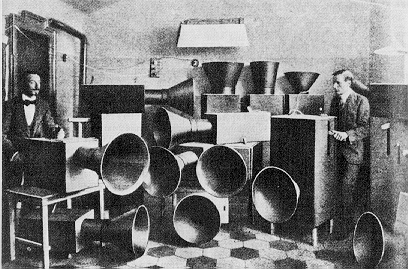 ~Photo of Russolo, Ugo Piatti and their “noise intoners” (intonarumori), Milan circa 1920.
"ConclusionsThe Art of Noises - Luigi Russolo
Futurist musicians must continually enlarge and enrich the field of sounds. This corresponds to a need in our sensibility. We note, in fact, in the composers of genius, a tendency towards the most complicated dissonances. As these move further and further away from pure sound, they almost achieve noise-sound. This need and this tendency cannot be satisfied except by the adding and the substitution of noises for sounds.
Futurist musicians must substitute for the limited variety of tones posessed by orchestral instruments today the infinite variety of tones of noises, reproduced with appropriate mechanisms.
The musician’s sensibility, liberated from facile and traditional Rhythm, must find in noises the means of extension and renewal, given that every noise offers the union of the most diverse rhythms apart from the predominant one.
Since every noise contains a predominant general tone in its irregular vibrations it will be easy to obtain in the construction of instruments which imitate them a sufficiently extended variety of tones, semitones, and quarter-tones. This variety of tones will not remove the characteristic tone from each noise, but will amplify only its texture or extension.
The practical difficulties in constructing these instruments are not serious. Once the mechanical principle which produces the noise has been found, its tone can be changed by following the same general laws of acoustics. If the instrument is to have a rotating movement, for instance, we will increase or decrease the speed, whereas if it is to not have rotating movement the noise-producing parts will vary in size and tautness.
The new orchestra will achieve the most complex and novel aural emotions not by incorporating a succession of life-imitating noises but by manipulating fantastic juxtapositions of these varied tones and rhythms. Therefore an instrument will have to offer the possibility of tone changes and varying degrees of amplification.
The variety of noises is infinite. If today, when we have perhaps a thousand different machines, we can distinguish a thousand different noises, tomorrow, as new machines multiply, we will be able to distinguish ten, twenty, or thirty thousand different noises, not merely in a simply imitative way, but to combine them according to our imagination.
We therefore invite young musicians of talent to conduct a sustained observation of all noises, in order to understand the various rhythms of which they are composed, their principal and secondary tones. By comparing the various tones of noises with those of sounds, they will be convinced of the extent to which the former exceed the latter. This will afford not only an understanding, but also a taste and passion for noises. After being conquered by Futurist eyes our multiplied sensibilities will at last hear with Futurist ears. In this way the motors and machines of our industrial cities will one day be consciously attuned, so that every factory will be transformed into an intoxicating orchestra of noises." ~Luigi Russolo - The Art of Noises

"The P22 Music Composition Font was proposed in 1997 to the John Cage Trust as an accompaniment to the John Cage text font based on the handwriting of the composer. The idea was basic and simple-every letter of the alphabet was assigned to a note on a scale. This would allow for any text to be converted into musical notation." ~ P22.com/musicfontP22 Music Text Composition Generator
"It’s pretty simple: Each node represents an event, and a connection from one node to the next triggers the next event after a certain number of tics. Nodes send MIDI note messages and/or MIDI controller change messages when triggered. Connecting nodes in a circuit lets you start a repeating pattern when one of the nodes is triggered.Tiction - Tink Thank
A node can change its pitch and controller values based on its position on the screen. When a node is triggered, it performs some physical action: either repelling or attracting other nearby nodes, or nudging itself in a random direction. The physical interaction between nodes allows you to construct complex, rhythmic melodies and effects without having to draw filter envelopes or touch a traditional sequencer"
~Tink Thank
 Pauline Oliveros - Photo by Pietr Kers
"As a musician, I am interested in the sensual nature of sound, its power of synchronization, coordination, release and change. Hearing represents the primary sense organ - hearing happens involuntarily. Listening is a voluntary process that through training and experience produces culture. All cultures develop through ways of listening.Open Space: Pauline Oliveros
Deep Listening® is listening in every possible way to everything possible to hear no matter what you are doing. Such intense listening includes the sounds of daily life, of nature, or one's own thoughts as well as musical sounds. Deep Listening represents a heightened state of awareness and connects to all that there is. As a composer I make my music through Deep Listening." ~Pauline Oliveros
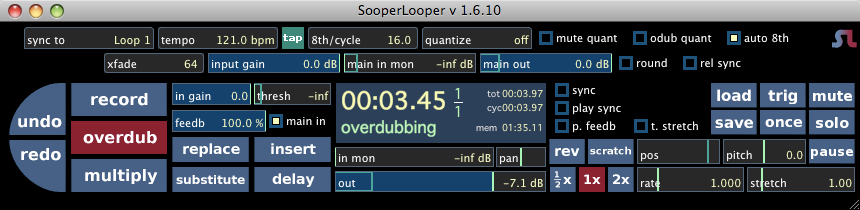 "SooperLooper is a live looping sampler capable of immediate loop recording, overdubbing, multiplying, reversing and more. It allows for multiple simultaneous multi-channel loops limited only by your computer's available memory."
 "Jack (the Jack Audio Connection Kit) is a low-latency audio server, written originally for the GNU/Linux operating system, and now with Mac OS X support. It can connect any number of different applications to a single hardware audio device; it also allows applications to send and receive audio to and from each other."
 Photo ("urban irony") by Life in a Lens from the Torontoist Flickr Pool.
 PROGRAMME - Movement is a defining aspect of Point Douglas; the train bisects the area, water defines its three sides, and the Disraeli bridge creates further disconnection form the rest of downtown. At another level, good and materials are collected, stored, and moved from place to place, while subtle changes are caused by weather and climate. The institute stems from an interest in how movement is continually redefining the site, surrounding areas in Point Douglas, and Winnipeg as a greater whole.


 Southwest corner of Watkins building. The institution is located at and below ground level next to the Watkins building and rail-line. This location facilitates the institute's function: recording (physical changes + vibrations on surrounding environment) + producing other vibrations in the forms of sound and movement. Immediately north are three rail-lines with regularly passing trains; to the southeast is the partially collapsed Able warehouse. This institute will collect information about changes occurring within + above the soil surface; ie: passing forces/movements on the surface, decaying/collapsing architecture, etc. The intent is to use the building to display (record visually) + amplify vibrations occurring in the surrounding area.


 "I propose to develop, with the aid of the theremin, projects for various machines for the automatic composition of music. L.S. Theremin considers such machines entirely feasible.... Under such conditions, musical works can be broadcast over the radio at the same time that they are being composed by the machine. The final aim of this work is to construct a synthetic machine capable of works of a higher order and with a greater degree of perfection than is accessible to living composers. The machine will be given only a general physico-mathematical idea, and the execution will proceed automatically." 'The Ether Wave Salon', pg. 134-135, "Theremin: Ether, Music, and Espionage" - Glinsky, 2000. (Image also from Glinsky, 2000)
 The resulting form with a growth rate of 0.95:
 The center portion of the form:
 "Polycycle 2 is installed onto large glass surfaces, and will draw or etch a slowly accumulat -ing rhythm of patterns over the duration of the show. The piece explores the nature of mark making onto a transparent/semi-opaque surface. The size of the mechanism is variable and thus can be adapted to suit a specific space or site. The resulting images explore the dialectic relationship between opposites and reversals and embody the fundamental nature of forces that brought it into existence." ~ BalintBolygo.com


